How to Insure Multiple Rental Properties Under One Program: Blanket Limits, Scheduled Locations, Deductibles, Valuation, and Claims
See How We're Different
or call us: (888) 585-5188

Simplifying Portfolio Management with a Single Insurance Program
Owners of two or three rental properties can often manage separate insurance policies without much friction. Once a portfolio grows to five, ten, or twenty locations, however, the administrative burden of tracking individual renewals, reconciling different coverage terms, and filing claims under separate contracts becomes a genuine operational risk in itself. A single master program that covers multiple rental properties under one policy, with blanket limits, scheduled locations, coordinated deductibles, and a unified claims process, eliminates much of that complexity while often reducing total premium costs. Shared and layered accounts in blanket programs saw rate decreases of roughly 18.7% in early 2026 as carriers increased competition for portfolio business, making this an opportune moment to consolidate.
The decision to insure rental properties under one program involves more than choosing a carrier. It requires a clear understanding of how blanket limits differ from scheduled coverage, how deductible structures affect out-of-pocket exposure, and how valuation methods determine the payout after a loss. Each of these elements interacts with the others, and getting one wrong can leave a gap that only becomes visible during a claim. This guide walks through each component, from structuring the policy to managing the claims process, so portfolio owners can make informed decisions that protect both their assets and their cash flow.
Blanket Limits vs. Scheduled Locations
The most fundamental choice in a multi-property insurance program is whether to use blanket limits or scheduled coverage. Each approach distributes risk differently, and the right fit depends on portfolio size, property value variation, and risk tolerance.
How Blanket Limits Provide Flexible Protection
A blanket limit pools the total insured value of all properties into a single coverage amount. If a portfolio contains ten buildings worth $500,000 each, a blanket policy might carry a $5 million limit that any single property can draw from. This structure is particularly useful when one location suffers a loss that exceeds its individual share of the total, because the full blanket amount remains available to cover that claim without triggering a shortfall.
The trade-off is cost. Blanket policies often carry slightly higher premiums because the insurer absorbs more concentration risk. They also frequently include margin clauses, which cap coverage at a percentage above the reported value for any single location, typically 110% to 125%. A margin clause prevents a single undervalued property from consuming a disproportionate share of the blanket.
Managing Individual Risks with a Statement of Values
Scheduled coverage assigns a specific insured value to each property on the policy. The carrier lists every location, its address, construction type, square footage, and declared value on a statement of values, or SOV, which functions as the policy's backbone. If a scheduled property suffers a loss, the payout is capped at that property's declared amount.
This approach works well for portfolios with significant value disparity between locations. A $2 million
fourplex and a $200,000
single-family rental
have different risk profiles, and scheduling each one ensures the premium reflects actual exposure. The downside is rigidity: if a property's value increases and the SOV is not updated, the owner faces a
coinsurance penalty at claim time.
Structuring Deductibles and Property Valuation
Deductible and valuation choices have a direct impact on both premium cost and out-of-pocket exposure after a loss. Getting these right requires balancing affordability with adequate protection.
Replacement Cost vs. Actual Cash Value for Portfolios
Replacement cost coverage pays to rebuild or repair a damaged property using materials of like kind and quality, without deducting for depreciation. Actual cash value, or ACV, subtracts depreciation from the payout. For a 20-year-old roof destroyed by hail, the difference can be tens of thousands of dollars.
Most portfolio owners with long-term hold strategies benefit from replacement cost coverage, even though it carries higher premiums. ACV policies make more financial sense for properties nearing disposition or those with limited remaining useful life. A mixed approach is also possible, where higher-value or newer properties carry replacement cost and older assets carry ACV, though this adds administrative complexity to the program.
Per-Occurrence vs. Per-Location Deductibles
A per-occurrence deductible applies once per event, regardless of how many properties are affected. If a single storm damages three buildings, the owner pays one deductible. A per-location deductible applies separately to each property involved in the loss, meaning that same storm could trigger three separate deductibles.
Per-occurrence deductibles are generally more favorable for portfolios concentrated in a single geographic area, where a single weather event could affect multiple locations simultaneously. Per-location deductibles tend to produce lower premiums and work well for geographically dispersed portfolios where the likelihood of a single event affecting multiple properties is low.
Comparing Individual Policies to a Master Program
Understanding the practical differences between managing separate policies and consolidating under a master program helps clarify why many portfolio owners eventually make the switch.
| Feature | Individual Policies | Master Program |
|---|---|---|
| Renewal dates | Multiple, staggered throughout the year | Single annual renewal |
| Coverage consistency | Varies by carrier and policy form | Uniform terms across all locations |
| Premium efficiency | No volume discount | Portfolio discount typically 10-20% |
| Claims coordination | Separate adjusters per carrier | Single adjuster, unified process |
| Administrative burden | High: tracking each policy separately | Low: one policy, one declaration page |
| Adding new properties | New application per property | Endorsement added mid-term |
| Coinsurance risk | Isolated to each policy | Managed through SOV or blanket |
The master program's efficiency becomes more pronounced as portfolio size increases. An owner with three properties may not notice much difference, but an owner with fifteen will spend significantly less time on insurance administration under a consolidated program.
Common Coverage Gaps in Multi-Property Programs
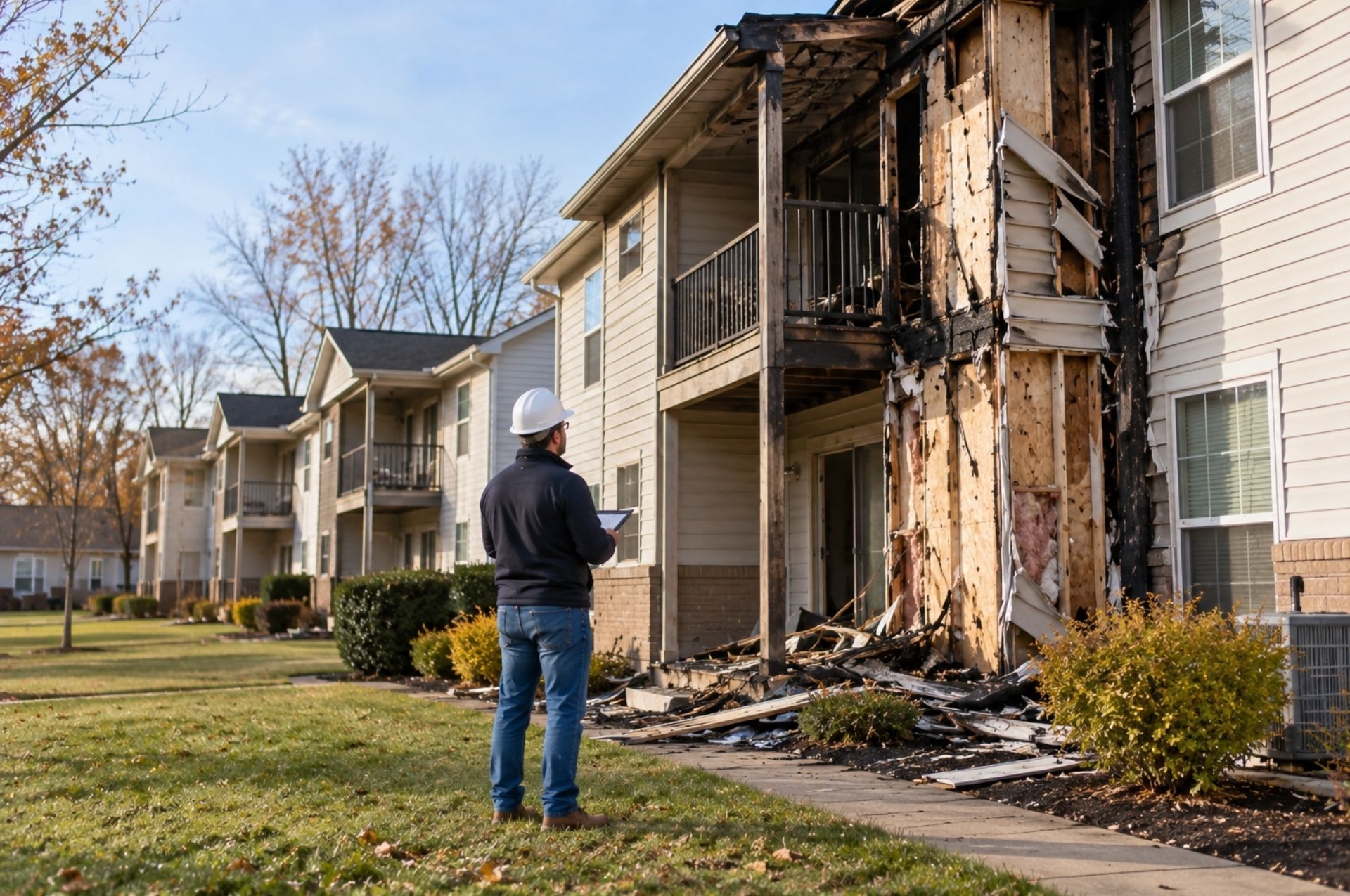
Even well-structured portfolio programs can leave gaps if certain exposures are overlooked. Loss of rental income coverage, for example, is not always included automatically and must be specifically endorsed. If a fire renders a duplex uninhabitable for six months, the owner loses rental revenue on top of the repair costs.
Ordinance or law coverage is another frequent omission. Older buildings damaged beyond a certain threshold may need to be rebuilt to current building codes, which can add 20% to 40% to reconstruction costs. Without this endorsement, the policy pays only to restore the building to its pre-loss condition, leaving the code-compliance gap unfunded.
Flood and earthquake coverage require separate policies or endorsements in nearly all programs, and umbrella or excess liability coverage should be considered for portfolios where tenant injury lawsuits could exceed underlying limits. Reviewing these gaps annually with a broker who specializes in rental portfolios is essential.
Navigating Claims Across Multiple Properties
Filing a claim under a multi-property program differs from the single-policy process in several important ways. The insurer assigns one adjuster to the entire portfolio, which streamlines communication but also means the adjuster must assess damage across multiple sites, sometimes in different cities or states.
Documentation is critical. Each property should maintain its own file containing the lease, rent roll, recent inspection photos, and a record of capital improvements. When a loss occurs, this documentation accelerates the adjuster's review and reduces disputes over pre-loss condition. For catastrophic events affecting several locations simultaneously, the claims process benefits from having a public adjuster or attorney who understands blanket and scheduled coverage mechanics.
One common mistake is failing to report a loss promptly at every affected location. Under a per-occurrence deductible, all damaged properties must be reported as part of the same event to avoid paying multiple deductibles. Delayed reporting at one location can result in the insurer treating it as a separate occurrence.
Frequently Asked Questions About Multi-Property Insurance
How many properties do I need before a blanket policy makes sense? Most carriers require a minimum of three to five locations, though some specialty programs accept as few as two. The financial benefit typically becomes clear at five or more properties.
Can I mix residential and commercial properties on one program? Yes, many master programs accommodate mixed-use portfolios. The underwriter will assess each property type separately but issue a single policy.
What happens if I sell one property mid-term? The carrier removes the property via endorsement and adjusts the premium accordingly. The remaining properties stay covered without interruption.
Do I still need separate liability coverage for each property? The master program typically includes general liability across all scheduled locations. Umbrella coverage can be added to extend limits above the underlying policy.
How often should I update my statement of values? At least annually, ideally 60 to 90 days before renewal. Properties that have undergone renovations or significant market appreciation should be updated immediately.
Will my lender accept a blanket policy instead of individual property coverage?
Most lenders will accept blanket coverage as long as their property is listed on the SOV and the
coverage meets or exceeds the loan balance. Some lenders require a specific endorsement naming them as loss payee.
The Role of Margin Clauses in Blanket Programs
Margin clauses act as a safety valve within blanket coverage. They allow the insurer to pay above the reported value for a specific location, typically by 10% to 25%, without requiring a formal appraisal or SOV update. This buffer protects against inflation-driven increases in construction costs that may not be reflected in the most recent valuation.
A property reported at $400,000 with a 25% margin clause would be covered up to $500,000 even if the SOV has not been updated. These clauses reduce the risk of being underinsured during periods of rapid construction cost escalation, which has been a persistent concern through 2025 and into 2026. Not all blanket programs include margin clauses by default, so confirming their presence and percentage is an important step during policy review.
How to Choose the Right Broker for Portfolio Insurance
A broker who specializes in rental property portfolios will have access to carriers and program administrators that generalist agents do not. Look for brokers with experience placing programs of similar size and property type, and ask specifically about their claims advocacy track record.
The right broker should be able to explain the trade-offs between blanket and scheduled coverage in the context of a specific portfolio, recommend appropriate deductible structures based on geographic concentration, and coordinate with lenders on loss payee requirements. A broker who simply quotes the lowest premium without discussing coverage structure is not providing adequate service for a multi-property account.
When to Transition from Individual Policies to a Consolidated Program
The tipping point varies by portfolio, but several signals indicate the time has come. If renewal dates are scattered across the calendar and consuming significant administrative time, consolidation brings immediate relief. If coverage terms differ between properties, creating confusion about what is and is not covered, a single policy form eliminates that ambiguity.
Portfolios that have experienced a claim denial due to coinsurance penalties or coverage gaps on an individual policy should treat that event as a catalyst for restructuring. The cost of a single uncovered loss often exceeds years of premium savings from cheaper individual policies.
Tax and Accounting Considerations for Master Programs
A consolidated insurance program simplifies tax reporting because the entire premium appears as a single line item rather than dozens of separate entries. Allocation of premium cost across properties for tax purposes can be handled using the SOV percentages, giving accountants a clear and defensible basis for expense distribution.
For owners using cost segregation or accelerated depreciation strategies, the valuation method chosen in the insurance program, whether replacement cost or ACV, should align with the accounting treatment of the underlying assets. Misalignment between insured values and book values can create audit questions and complicate loss recovery calculations.
Making the Right Choice for Your Portfolio
Insuring multiple rental properties under a single program is not simply a matter of convenience. It is a strategic decision that affects premium cost, claims outcomes, and administrative efficiency across the entire portfolio. The choice between blanket limits and scheduled coverage, the deductible structure, and the valuation method all interact to determine how well the program performs when a loss actually occurs.
Start by building an accurate statement of values for every property in the portfolio. Work with a broker who has specific experience in multi-property programs and can explain how margin clauses, coinsurance provisions, and coverage endorsements apply to each location. Review the program annually, update valuations to reflect current construction costs, and confirm that loss of income, ordinance or law, and umbrella coverages are in place.
The 2026 market conditions, with carriers competing aggressively for portfolio business and rates declining for well-structured accounts, create a favorable environment for owners considering consolidation. Those who act now can lock in competitive terms while building a coverage foundation that scales with their portfolio.
Recent posts