Catastrophe Limits for Real Estate Investment Portfolios: Wind, Flood, Fire, Shared Deductibles, Aggregation, and Recovery
See How We're Different
or call us: (888) 585-5188
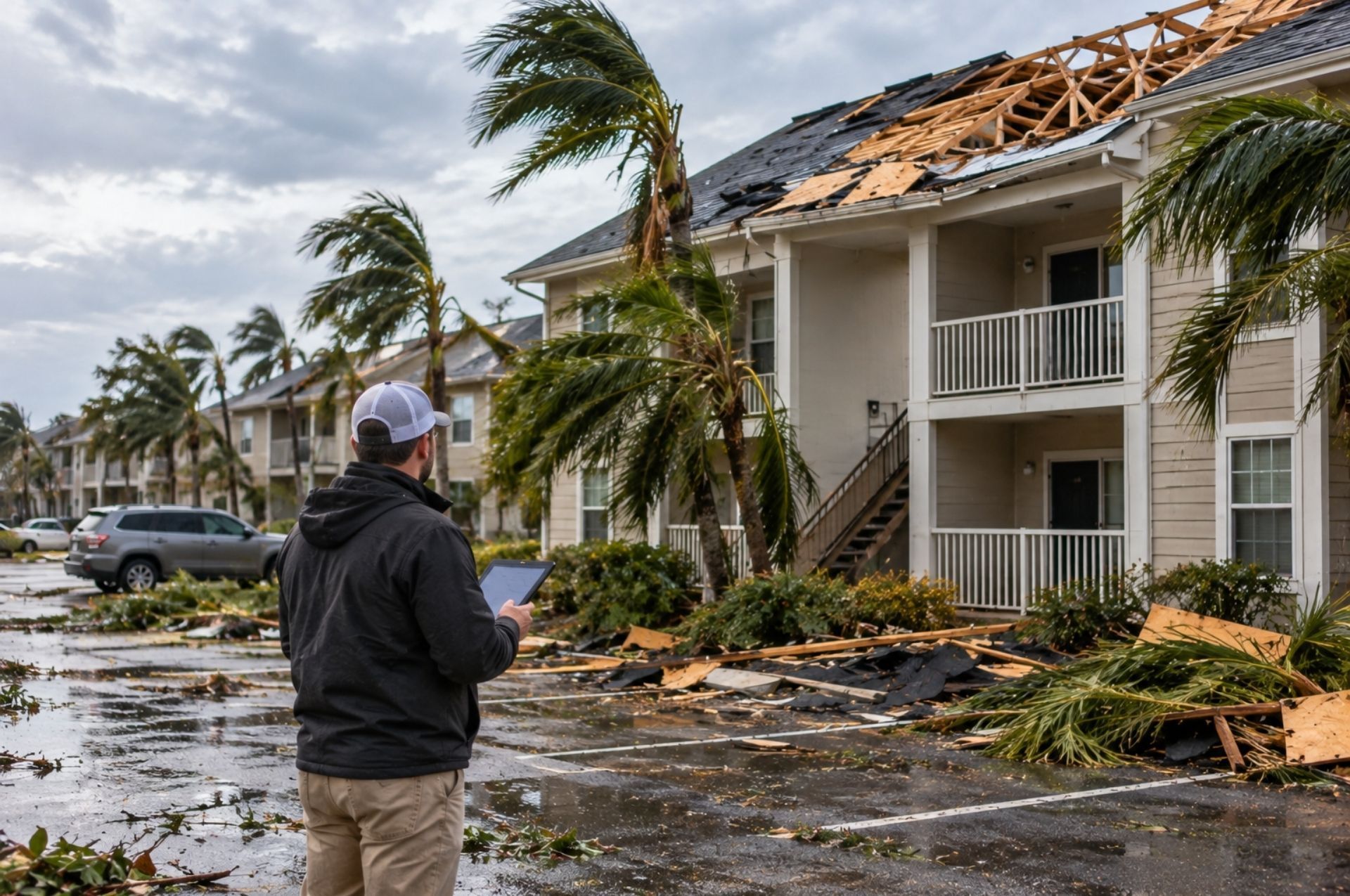
A single hurricane, wildfire season, or inland flood event can wipe out years of rental income and equity appreciation across an entire real estate investment portfolio in a matter of days. The difference between a recoverable setback and a catastrophic financial loss often comes down to how catastrophe limits, deductibles, and aggregation provisions are structured across the portfolio's insurance program. For institutional investors, REITs, and private equity sponsors holding dozens or hundreds of properties across multiple states, understanding how wind, flood, and fire sub-limits interact with shared deductibles and loss recovery mechanisms is not optional: it is foundational to capital preservation. Global commercial property insurance rates declined by 6% in Q2 2026, marking the eighth consecutive quarter of price reductions, which has created a window for portfolio owners to restructure catastrophe programs on more favorable terms. That said, softer pricing does not mean softer risk. The frequency and severity of catastrophe events continue to climb, and portfolios that fail to match their limit structures to their actual exposure profiles remain dangerously vulnerable. This guide breaks down the mechanics of catastrophe coverage for real estate portfolios, from peril-specific sub-limits through aggregation risk and post-loss recovery.
Understanding Catastrophe Limits in Real Estate
Catastrophe limits in real estate insurance programs function differently from standard property coverage. A standard all-risk policy covers losses from everyday perils like fire, theft, or water damage up to the full policy limit. Catastrophe coverage, by contrast, typically applies a separate, lower sub-limit for named perils such as windstorm, flood, or earthquake, and these sub-limits often apply across the entire portfolio rather than per property. The distinction matters enormously because a single catastrophe event can damage multiple assets simultaneously, and the sub-limit caps the insurer's total payout for that event regardless of how many properties are affected.
The Difference Between Blanket Limits and CAT Sub-limits
A blanket limit provides a single coverage amount that applies across all scheduled properties, allowing the insured to allocate coverage where the loss actually occurs. A catastrophe sub-limit, however, sits beneath the blanket limit and restricts recovery for specific perils. For example, a portfolio might carry a $500 million blanket property limit but only a $75 million named windstorm sub-limit. If a hurricane damages eight properties with combined replacement costs of $120 million, the portfolio recovers only $75 million minus the applicable deductible. Investors who confuse their blanket limit with their catastrophe limit often discover the gap only after a loss, which is precisely the wrong time to learn the difference.
Probability and Probable Maximum Loss (PML) Studies
PML studies use catastrophe modeling software to estimate the maximum loss a portfolio is likely to sustain from a single event at various return periods, typically 100-year, 250-year, and 500-year intervals. These models account for construction type, geographic concentration, elevation, and proximity to coastlines or fault lines. Lenders and equity partners increasingly require PML studies before committing capital, and emerging insurance threat modeling for 2026 shows that exceedance probabilities are shifting upward for several peril types. A well-executed PML study directly informs the selection of catastrophe sub-limits, ensuring the portfolio purchases enough coverage to survive its modeled worst-case scenario without overpaying for limits it is statistically unlikely to need.
Specific Perils: Wind, Flood, and Fire Management
Each catastrophe peril carries its own underwriting characteristics, deductible structures, and market dynamics. Treating them as interchangeable is a common and costly mistake.
Wind and Hail: Managing Tier 1 Coastal Exposure
Properties within Tier 1 wind zones, generally defined as locations within one mile of the coast, face the highest windstorm deductibles, often 5% of the insured value per building. A $20 million coastal apartment complex could carry a $1 million wind deductible before any recovery begins. The 2026 commercial property insurance outlook suggests that while overall rates have softened, wind-exposed coastal properties remain a pocket of resistance where carriers are holding firm on pricing and deductible levels. Portfolio managers should consider parametric wind triggers or standalone wind-only policies to supplement their master program in heavily concentrated coastal markets.
Flood Zones and Excess National Flood Insurance Program (NFIP) Layers
Properties in FEMA-designated Special Flood Hazard Areas (zones A and V) typically require flood coverage as a condition of any federally backed mortgage. The NFIP provides up to $500,000 in building coverage for commercial properties, a figure that falls far short of replacement cost for most investment-grade assets. Excess flood policies bridge the gap, but they carry their own sub-limits and often exclude certain loss types such as storm surge in coastal V zones. Portfolio-level flood programs can aggregate NFIP base layers with a single excess tower, but the coordination between the federal program and private excess layers requires careful attention to avoid coverage gaps at the transition point.
Wildfire Risk and Urban-Interface Protections
Wildfire exposure has expanded well beyond traditional rural areas into the wildland-urban interface (WUI), where residential and commercial developments meet undeveloped land. Portfolios with assets in California, Colorado, Oregon, and parts of the Mountain West face increasingly restrictive underwriting for fire risk. Carriers now commonly require defensible space documentation, ember-resistant vent certifications, and vegetation management plans before offering coverage. Some condominium and
multifamily insurance programs in the Pacific Northwest have seen carriers exit entirely from WUI-adjacent risks, forcing owners into state-backed FAIR plans with lower limits and higher costs.
Shared Deductibles and Loss Aggregation
The way deductibles and limits aggregate across a multi-property portfolio can dramatically alter the economics of a catastrophe loss. This is where the structural design of the insurance program matters most.
How Occurrence Encapsulation Works for Multiple Properties
Most catastrophe programs define coverage on a per-occurrence basis, meaning all damage from a single event, such as one hurricane, is treated as one loss. A shared occurrence deductible applies once to the entire event rather than separately to each property. If a portfolio carries a $2 million per-occurrence wind deductible and a hurricane damages five properties, the owner pays $2 million total, not $2 million per building. This structure benefits diversified portfolios but requires careful tracking of which properties fall within the occurrence definition, as disputes over whether damage at distant properties constitutes one occurrence or multiple can delay claims significantly.
The Risk of Limit Erosion Across a Portfolio
Limit erosion occurs when multiple losses within a policy period consume the available catastrophe sub-limit, leaving insufficient coverage for subsequent events. A portfolio with a $50 million annual aggregate flood sub-limit that sustains a $35 million spring flood loss enters hurricane season with only $15 million remaining. Reinstatement provisions, which allow the insured to "buy back" eroded limits for an additional premium, are a critical but often overlooked component of catastrophe programs. The
real estate industry insurance outlook for 2026 highlights that reinstatement pricing has become more favorable in the current soft market, making this an opportune time to negotiate broader reinstatement terms.
Comparison of CAT Coverage Structures
| Feature | Standard Blanket Policy | Portfolio CAT Program | Standalone Peril Policy |
|---|---|---|---|
| Wind Sub-limit | Often low or excluded | Dedicated sub-limit, typically $25M-$200M | Full policy limit for wind only |
| Flood Coverage | NFIP base only | NFIP + excess flood tower | Private flood, full replacement |
| Deductible Type | Per-building, flat dollar | Per-occurrence, percentage-based | Varies by peril and zone |
| Aggregation | No annual aggregate cap | Annual aggregate with reinstatement | Per-occurrence only |
| PML Alignment | Rarely modeled | Modeled to 250-year return period | Modeled per peril |
| Best For | Small, geographically concentrated portfolios | Large, diversified portfolios | High-exposure single-peril risks |
This comparison illustrates why a single policy structure rarely fits a diversified real estate portfolio. The June 2026 insurance market report confirms that multi-layered portfolio programs with peril-specific towers continue to deliver better risk-adjusted pricing than monoline approaches for portfolios exceeding $250 million in total insured value.
Strategies for Recovery and Claims Optimization
Purchasing the right catastrophe limits is only half the equation. Recovering the full value of a loss requires deliberate preparation and documentation discipline.
Business Interruption and Rent Loss Recovery
Business interruption (BI) and rent loss coverage replaces income lost while damaged properties are being restored. For real estate portfolios, this coverage is often the most valuable component of a catastrophe claim because the income stream, not the physical structure, is the primary asset. Rent loss policies typically cover the period of restoration plus an extended period of indemnity, but the calculation of lost income can become contentious when occupancy was already declining or when tenants had lease termination rights. Portfolios that carry rent loss insurance should maintain current rent rolls, lease abstracts, and trailing-twelve-month financial statements for every property to support their claims.
Documentation Requirements for Large Scale Losses
Large catastrophe claims require an organized documentation effort that begins before any event occurs. Pre-loss inventories, including photographs, equipment schedules, and building condition reports, form the foundation of any successful claim. Post-loss, the insured must track all mitigation expenses, temporary repairs, and professional fees separately from permanent restoration costs. Hiring a public adjuster or forensic accountant within the first 72 hours of a major loss can increase recovery by 15% to 30% compared to self-managed claims, particularly when coverage gaps in rental property insurance complicate the allocation of costs between covered and uncovered perils.
Common Questions About CAT Limits
What is the difference between a catastrophe sub-limit and a policy limit? A policy limit is the maximum the insurer will pay for all covered losses. A catastrophe sub-limit is a lower cap that applies only to specific perils like wind, flood, or earthquake within that same policy.
Do all properties in a portfolio share the same catastrophe deductible? In most portfolio programs, yes. A per-occurrence deductible applies once to all properties damaged in a single event, though some programs impose minimum per-location deductibles as well.
How often should PML studies be updated? At least every two to three years, or whenever the portfolio adds or disposes of significant assets, changes construction at existing properties, or when new catastrophe model versions are released.
Can catastrophe limits be reinstated after a loss? Many programs include reinstatement provisions that restore eroded limits for an additional premium, typically calculated as a percentage of the original catastrophe layer cost.
Is flood coverage included in standard commercial property policies? Rarely. Most commercial property policies exclude flood entirely or provide minimal coverage. Dedicated NFIP policies and private excess flood layers are required for meaningful protection.
What triggers a named windstorm deductible versus a standard deductible? The policy defines the trigger, which is usually tied to a storm receiving a name from the National Hurricane Center or sustained winds exceeding a specified threshold, often 74 mph.
The Bottom Line for Your Portfolio
Catastrophe limits for real estate investment portfolios require a level of structural precision that goes well beyond selecting a coverage amount and paying a premium. Wind, flood, and fire each demand peril-specific sub-limits calibrated to PML studies, while shared deductibles and aggregation provisions determine whether a multi-property loss is survivable or devastating. The current soft market, with property insurance premiums trending downward through mid-2026, offers a rare opportunity to restructure catastrophe programs, secure broader reinstatement terms, and close coverage gaps that may have persisted during the hard market years of 2022 through 2024.
Portfolio owners and asset managers should use this window to commission updated PML studies, stress-test their aggregation limits against realistic multi-event scenarios, and ensure their documentation protocols are ready to support rapid, high-value claims recovery. The properties that weather the next catastrophe best will not be the ones that avoided the storm: they will be the ones whose insurance programs were built to absorb it.
Recent posts